
Good Heavens. I posted the piece on medieval plunderers in Belgium to add a little color -- a lighter side, if you will -- to the Proving Ground's stellar, Pulitzer-caliber political reporting and analysis. It was meant to have its 15 minutes of fame and then slip quietly into the archives, to live out the rest of its days humbly and contentedly.
Little did I know that it would be the feature article for a week, causing our legions of readers to mistakenly believe this is a blog about Belgium, or Maximilian I.
Well, the article is not one to hog the stage, so it hereby passes the torch to the latest George Monbiot article, which picks apart the incredible lunacy and hypocrisy of climate skeptics thinking that they are the ones being censored.
The Real Climate Censorship - I'm not going to pull out any quotes. Read the whole thing.
Showing posts with label global warming. Show all posts
Showing posts with label global warming. Show all posts
Thursday, April 12, 2007

Wednesday, February 21, 2007
Wednesday, February 14, 2007
Global Warming Doesn’t Matter (Part 2 of 2)
Is ethanol the answer?
As for the debate over ethanol, I agree with Brett on most points. Ethanol is no silver bullet. To extend the analogy, it may be more of a rubber bullet. We really haven’t seen conclusive evidence that ethanol will produce a significantly greater amount of energy than the fossil fuels required to create it. All of the hype is coming from corn-producers and the governments (state and federal) that subsidize them.
If we are to use ethanol as a means of alternative energy, it would be best to use the most efficient types of biomass to produce it. This means using sugarcane instead of corn, as ethanol derived from sugarcane is more efficient. Brazil is currently the world’s largest producer of sugarcane ethanol, but the U.S. is currently imposing trade restrictions on its sale in the state to bolster domestic production of ethanol. (I hate to source Wikipedia here… but it’s the most comprehensive source I could find right now)
Oddly enough, it is several Senate Democrats including Sen. Tom Harkin (D-IA) and Sen. Barack Obama (D-IL) are urging President Bush to maintain the current trade restrictions in an effort to support corn ethanol producers. Read their letter to President Bush. Democrats including Senators Byron Dorgan (D-ND), Dick Durbin (D-IL), Tim Johnson (D-SD) and Barack Obama (D-IL). It seems that serving their already-heavily-subsidized corn-producing constituents is more important than finding the most efficient fuel source for Americans.
Even with sugarcane ethanol, there’s the issue of the fuel costs to transport it to the U.S.
The solution to decreasing atmospheric pollution, slowing global warming, protecting ourselves from the exhaustion of fossil fuels, or whatever other energy-related problems you may think we have begins with investment in a “diverse portfolio” of renewable energy solutions.
Ethanol isn’t the end-all-be-all of fuel sources. There is no one answer, despite what our politicians might be telling us. In areas where there is lots of sunlight, install solar panels. In areas with lots of wind, install wind turbines. And so forth.
Moving energy only wastes energy. The farther you have to move fuel or the longer your electrical lines are, the less benefit there is.
Conclusion
Unfortunately, global warming is being used by anti-environmentalists and oil company cronies as an easy target. The media is displaying the question as being about whether or not there is global warming. The issue really should be boiled down into two facts: 1) Pollution harms human health and the environment 2) Fossil fuels won’t last forever.
Brett’s completely right that it would be careless to waste taxpayer dollars on research that is unnecessary and unlikely to produce real results. But, energy and sustainability research is absolutely necessary and has already produced results. The longer we wait to combat our energy problems, the tougher they’re going to be. In the end, I’m confident that the time, energy, and resources spent limiting our contribution to air pollution and lowering our dependence on fossil fuels will most not have been wasted.
As Brett noted, only 1% of the U.S. budget is spent on science and technology. I can only assume that major portions of that 1% go to medical and military research. And even the money we’re using for energy development is being spent on the wrong thing. According to the U.S. Dept. of Energy, “our economic health depends on the continued availability of reliable and affordable fossil fuels”. They are still pouring money into, “research and development of future fossil energy technologies”.
It’s about time we stop living in the industrial revolution and start working towards a sustainable future.
Global Warming Doesn’t Matter (Part 1 of 2)
 In the last few years, it has become a widely acknowledged scientific fact that global warming is a dire and urgent issue facing the human race. However, there are some who still deny its existence or downplay its significance.
To them, I say: global warming doesn’t matter.
Let’s say, for the sake of argument, that global warming won’t cause the ice caps and glaciers to melt. Let’s assume that the oceans won’t rise to drive millions from their homes and the weather won’t change in unpredictable and dangerous ways.
The main rationale of those who deny global warming is that human action isn’t the cause for global climate change. Even if this were a logical argument, it is impossible to argue that human action has no effect on the environment.
Whether or not it heats up the earth, air pollution is harmful
Regardless of its effect on climate change, air pollution is extremely dangerous to both humans and the environment.
According to CBS News:
“Air pollution threatens the health of human beings and other living things on our planet. While often invisible, pollutants in the air create smog and acid rain, cause cancer or other serious health effects, and diminish the protective ozone layer in the upper atmosphere…”Pardon the double negative, but you can’t argue that air pollution is not bad… no matter how much the oil companies pay you.
It’s so easy to ignore or hide facts that, if accepted, would demand a change in the western life of convenience and, to be honest, excess, that we in the U.S. have come to accept and embrace. I understand that it’s tough for any politician to get re-elected by telling voters that they shouldn’t use as much electricity and shouldn’t drive as much. In fact, politicians are trying to promote renewable resources right now as a means of continuing our current lifestyles. They argue that average citizens shouldn’t have to pay more for gasoline and energy. Very few of our representatives make the argument for conservation and efficiency.
Many of those who actually deny global warming due so in an effort to support the unbridled right of humans to consume as much energy and fuel as they please. Most of these so-called experts also happen to be paid by oil companies. One example is Chris Horner, author of The Politically Incorrect Guide to Global Warming and Environmentalism (more like the "Idiot's Guide) and counsel for the Competitive Enterprise Institute, which has received over $1.3 from ExxonMobil.
Even if oil companies stand to make billions from the sale of fossil fuels, it is impossible to argue that fossil fuels will last forever.
Fossil fuels, by definition, are non-renewable. We can’t create more fossil fuel, at least not without burying tons of biomass far beneath the earth’s crust and waiting around for hundreds of millions of years.
The undeniable fact is that fossil fuels will run out. And, if we keep gobbling them up like Takeru Kobayashi, we’re going to face a world-wide energy shortage all too soon.
To be continued...
Saturday, January 27, 2007
A Look Down the Barrel of the Global Warming Gun
Cross-posts: Daily Kos; Brudaimonia
As many who follow global warming know, Bangladesh is one of the countries most vulnerable to the potential meteorological consequences of global warming. There are several good reasons why, which I detail below.
This diary serves to give a detailed profile of Bangladesh and what might happen if some of the events projected by climatologists due to global warming come true. Having spent a month in Bangladesh a few years ago, having experienced the genuine kindness and hospitality of many Bangladeshis, and having several friends there now, global warming's threat to the country is somewhat personal for me.
Three major rivers -- the Ganges (known locally as the Padma), the Jamuna, and the Meghna -- course through Bangladesh before emptying into the Bay of Bengal. Composed of, for the most part, the collective delta of these three rivers, the country's terrain (with small highland exceptions in the north and in the Chittagong Hill Tracts in the southeast panhandle) is mostly flat alluvial plain (i.e. low and wet). It has one of the lowest average elevations of any country. (Elevation map)
These geographical conditions place Bangladesh on the edge of the cliff. If the climate model results reported in the New Scientist in 2003 come even close to being true, the land will be pushed over the edge:
The threat to Bangladeshis of a sea-level rise and increased river flooding is exacerbated by its population density, the highest in the world of any sizable country. Imagine half the US population living in Iowa; that's Bangladesh's population density.
When I visited, it was not the monsoon season, when one-third of the country is under water (CIA World Factbook). But even in the dry season, the amount of land available for farming can be scarce in some areas.
(Bru)
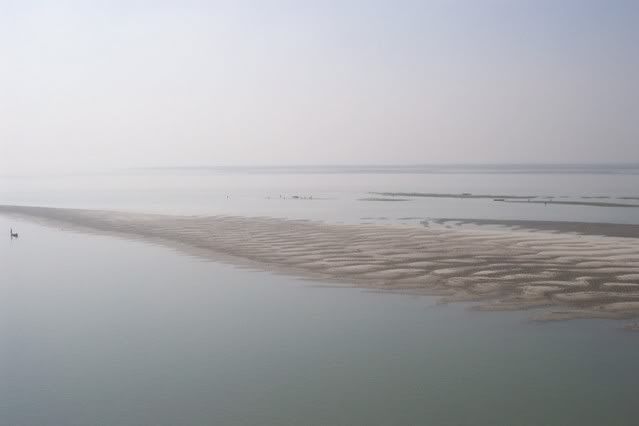
This is a view from the Bangabandhu Jamuna Bridge, a massive and modern bridge named after Sheikh Mujibur Rahman, Bangladesh's founding father. (His nickname was "Bangabandhu," or "Friend of Bengal" in Bengali.) The small dots near the sand chars in the middle of the river are farmers in boats. This is a telling example of the shortage of land in Bangladesh: farmers take advantage of any piece of arable land they can get, even if it bears a high risk of flooding and destroying their crops.
A significant rise in sea level may tighten the land crunch beyond repair. According to my Lonely Planet book, "A 1m rise in the Bay of Bengal would result in a loss of 12% to 18% of the country's land" (p. 35).
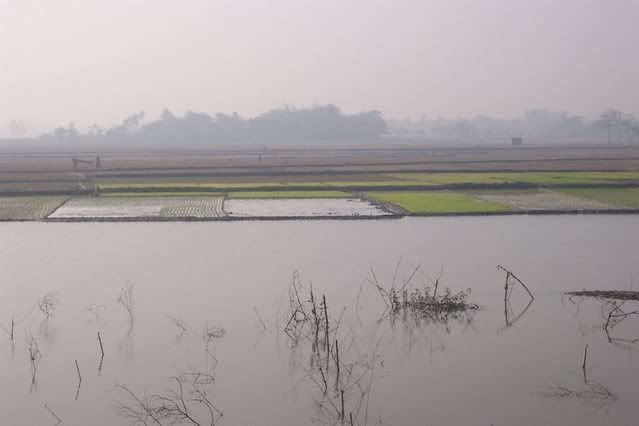
(Rice nurseries near water's edge - Bru)
Another threat of rising sea levels is infiltration of salt water in fresh water bodies and aquifers. This is especially troubling in a region where half of the tubewells are already contaminated with arsenic.
Already Bangladesh is experiencing an increase in urbanization as the rural poor and environmental refugees flock to Dhaka and other large cities.
(Bru)
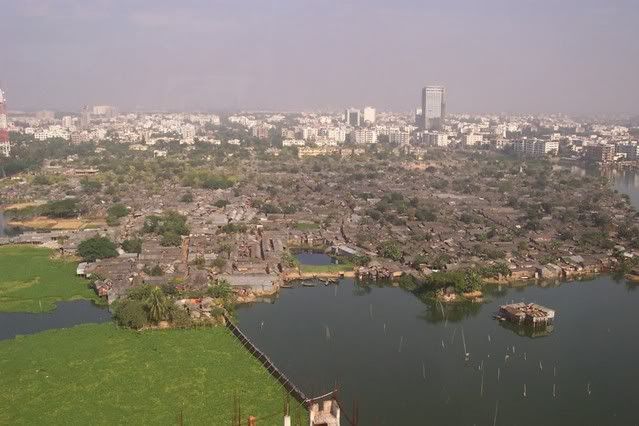
The grey roofs you see in the foreground all make up one large slum. You can see how it stretches to the edges of the lake, even if the ground doesn't provide a solid foundation. If the migration into Dhaka increases according to projections, where will all these new people live? What will they eat and what water will they drink? These are huge problems that Bangladesh would have to deal with no matter what happens to the earth's climate, but global warming threatens to make them much worse.
Bangladeshis are used to flooding and natural disasters. Besides the normal monsoon flooding every year, they have been hit on occasion by excpetionally bad floods. This happened in 1999, 2002, and 2003 , to name just three recent years. In 1991, a cyclone killed over 130,000 people. In 1970, the Bhola cyclone killed at least 500,000 people, the deadliest tropical cyclone of all time.
In the wake of all these disasters, Bangladesh has improved its response system and disaster planning. But no amount of planning may prepare them for the potential consequences, and ripple effects, of a significant average global temperature rise.
I have been reading parts of Aldo Leopold's A Sand County Almanac lately, and have been marveling at how ahead of its time it is, given that it was published in 1949. In "The Land Ethic," Leopold argues that our ethical systems must evolve to take into account the entire community of life, not just other individuals or human society in general.
We don't have to wait for the government to do anything. We don't have to wait for CAFE standards to be raised or for Wal-Mart to sell a bunch of CFLs. We don't have to wait for utilities to add more renewable energy. We can adopt (or cultivate) our own Land Ethic, within ourselves. And if enough of us do this, we might find that we have saved Bangladesh -- not to mention Ethiopia or New Orleans -- from the worst global warming consequences.
As many who follow global warming know, Bangladesh is one of the countries most vulnerable to the potential meteorological consequences of global warming. There are several good reasons why, which I detail below.
This diary serves to give a detailed profile of Bangladesh and what might happen if some of the events projected by climatologists due to global warming come true. Having spent a month in Bangladesh a few years ago, having experienced the genuine kindness and hospitality of many Bangladeshis, and having several friends there now, global warming's threat to the country is somewhat personal for me.
Three major rivers -- the Ganges (known locally as the Padma), the Jamuna, and the Meghna -- course through Bangladesh before emptying into the Bay of Bengal. Composed of, for the most part, the collective delta of these three rivers, the country's terrain (with small highland exceptions in the north and in the Chittagong Hill Tracts in the southeast panhandle) is mostly flat alluvial plain (i.e. low and wet). It has one of the lowest average elevations of any country. (Elevation map)
These geographical conditions place Bangladesh on the edge of the cliff. If the climate model results reported in the New Scientist in 2003 come even close to being true, the land will be pushed over the edge:
Flooding in the country is set to increase by up to 40 per cent this century as global temperatures rise, the latest climate models suggest.Granted, the 40 percent figure is the worst case scenario, but even
[snip]
...heavier rainfall triggered by global warming will swamp Bangladesh's riverbanks, a previously unforeseen effect, flooding between 20 and 40 per cent more land than today, says Monirul Qader Mirza, a Bangladeshi water resources expert now at the Adaptation and Impacts Research Group at the University of Toronto.
...People can grow crops on land regularly fertilised by nutrient-laden silt from the rivers [see photo below]. But extreme floods cause considerable hardship and loss of life: in 1988 and 1998 over two-thirds of the country was under water at some point.
[i]f temperatures rose by just 2 °C, two of the models showed that the mean flow of the Meghna and Brahmaputra rivers would increase by 20 per cent. (New Scientist Article)What will it take to give ourselves a good chance of (but not ensure) avoiding a 2 °C raise and increase the likelihood of sparing Bangladeshis great hardship? According to this seminal article by George Monbiot (related to his new book), it will take a 60% global reduction of greenhouse gases, a 90% average cut by rich countries, and a 94% cut by the U.S by 2030. If this reasoning is even close to the mark, things look really bad for Bangladesh.
The threat to Bangladeshis of a sea-level rise and increased river flooding is exacerbated by its population density, the highest in the world of any sizable country. Imagine half the US population living in Iowa; that's Bangladesh's population density.
When I visited, it was not the monsoon season, when one-third of the country is under water (CIA World Factbook). But even in the dry season, the amount of land available for farming can be scarce in some areas.
(Bru)
This is a view from the Bangabandhu Jamuna Bridge, a massive and modern bridge named after Sheikh Mujibur Rahman, Bangladesh's founding father. (His nickname was "Bangabandhu," or "Friend of Bengal" in Bengali.) The small dots near the sand chars in the middle of the river are farmers in boats. This is a telling example of the shortage of land in Bangladesh: farmers take advantage of any piece of arable land they can get, even if it bears a high risk of flooding and destroying their crops.
A significant rise in sea level may tighten the land crunch beyond repair. According to my Lonely Planet book, "A 1m rise in the Bay of Bengal would result in a loss of 12% to 18% of the country's land" (p. 35).
(Rice nurseries near water's edge - Bru)
Another threat of rising sea levels is infiltration of salt water in fresh water bodies and aquifers. This is especially troubling in a region where half of the tubewells are already contaminated with arsenic.
Already Bangladesh is experiencing an increase in urbanization as the rural poor and environmental refugees flock to Dhaka and other large cities.
Masuma's home is a bamboo and polythene shack in one of the hundreds of slums colonising every square metre of unbuilt land in Dhaka, the capital of Bangladesh.A third of Dhaka's population lives in slums (Source). While there, I learned that future increases in the city's slum population will help make it the world's second-most populous city by 2020.
Masuma is an environmental refugee, fleeing from the floods which have always beset her homeland but which are predicted to strike more severely with climate change.
(Bru)
The grey roofs you see in the foreground all make up one large slum. You can see how it stretches to the edges of the lake, even if the ground doesn't provide a solid foundation. If the migration into Dhaka increases according to projections, where will all these new people live? What will they eat and what water will they drink? These are huge problems that Bangladesh would have to deal with no matter what happens to the earth's climate, but global warming threatens to make them much worse.
Bangladeshis are used to flooding and natural disasters. Besides the normal monsoon flooding every year, they have been hit on occasion by excpetionally bad floods. This happened in 1999, 2002, and 2003 , to name just three recent years. In 1991, a cyclone killed over 130,000 people. In 1970, the Bhola cyclone killed at least 500,000 people, the deadliest tropical cyclone of all time.
In the wake of all these disasters, Bangladesh has improved its response system and disaster planning. But no amount of planning may prepare them for the potential consequences, and ripple effects, of a significant average global temperature rise.
I have been reading parts of Aldo Leopold's A Sand County Almanac lately, and have been marveling at how ahead of its time it is, given that it was published in 1949. In "The Land Ethic," Leopold argues that our ethical systems must evolve to take into account the entire community of life, not just other individuals or human society in general.
In short, a land ethic changes the role of Homo sapiens from conqueror of the land-community to plain member and citizen of it. It implies respect for his fellow-members, and also respect for the community as such.For global warming, we have to fight our subconscious tendency to only pay attention to localized problems, and consider the effect on the global community. We have to treat a threat to people halfway around the world as a threat to our neighbor or ourselves, because that's what we would want people halfway around the world to do if the threat was to us or our neighbor, especially if we knew that our actions influenced this threat.
We don't have to wait for the government to do anything. We don't have to wait for CAFE standards to be raised or for Wal-Mart to sell a bunch of CFLs. We don't have to wait for utilities to add more renewable energy. We can adopt (or cultivate) our own Land Ethic, within ourselves. And if enough of us do this, we might find that we have saved Bangladesh -- not to mention Ethiopia or New Orleans -- from the worst global warming consequences.
Subscribe to:
Posts (Atom)